Come For The Banter - Stay For The Disappointment
Nucks Fan Rebuild & Retool Center - Come For The Banter - Stay For The Disappointment


Yes, obviously. And no, where it matters. In the short term, at least.
There was a full season's worth of roller coasters in the past four games. It was set off by spoiling Edmonton's home opener for them, for which they returned the favour in spectacularly ridiculous fashion. Then a team some of us Olds remember as a rival in Calgary. We finished off the week with a team those same Olds think of as "just started last season": the Vegas Golden Knights.
It was wild. It was fun. It was...good?
Before the season started, there were the usual questions:
What would Manny Malhotra's coaching style be? Could Elias Pettersson the Forward make a comeback of any kind? How would the defensive pairings sort out, and are too many of them too inexperienced? Where the heck would the goals come from? How big a role will injuries play?
We got a few answers already, but only because they're the questions we kinda didn't want to have resolved this early.
Filip Chytil and Thatcher Demko being out before the season started is disturbing. The only clue that Demko wouldn't be ready was how far into training camp he went without skating as part of the club. And Chytil... Well, at least it wasn't a concussion this time? I guess?
Leevi Meriläinen coming in was a pleasant surprise. He is a better goaltender than Nikita Tolopilo, and a bit younger to boot. It bumped Aku Koskenvuo down to Kalamazoo again, which has got to annoy him. Unfortunately, there's only so much room in the AHL right now, and Ty Young won the coin toss.
The team has decided to carry eight defencemen and thirteen forwards early on, which seems fine. Guillaume Brisebois understands that he's up as that eighth man and is unlikely to see the ice before Victor Mancini does. On the other hand, they are heading out on a six-game East Coast roadie, and that's not a bad spot for a spare. Either blueliner can play up front in a pinch, but I wouldn't be thrilled to see Aatu Räty man the blue line.
Speaking of which, Räty was scratched for two, in for two, trading off with Jake DeBrusk. Not directly, but the usual bumping up the lines - which is where we get to talk about Paul Cotter.
What a find, eh? A feisty, big American with surprising speed and underappreciated scoring gets his chance in Vancouver as a free agent, and we get the rewards! Here's Cotter, this year's Kiefer Sherwood, who was that year's Dakota Joshua, scoring the Canucks' first goal of the season. And then he just kept going, now with four goals and six points in four games.
Those offensive numbers can be laid partially at the feet of the Oilers, who took a couple games to realize the season had started. Vancouver scored 13 goals against them in two games, kickstarting their offence and making a lot of players - and fans - very happy. A sudden discovery of scoring depth meant that, as of now, only two regulars are missing points: Brendan Gallagher and Zeev Buium.
Gallagher's no surprise, given he's a fourth-liner, but Buium is, given his primary partner is Mister Everything Filip Hronek. Hronek has five assists so far, but no seconds for Buium yet. It'll come, but "soon" rather than "now". There's very little anxiety among the fans this time out, and no one is screaming for the sophomore's head. And do we need to talk about Pettersson the Forward leading the team in not just points, but hits?
Now, giving up 14 goals in those same two Oilers games wasn't great, but it was fun. Which is the crux of the question.
If you wanted to win this season, no. Holy smoke, no. Holes abound through the lineup; the youth on defence is regularly exposed; and the competition hasn't been the league's finest. But isn't that kinda the point?
Anyone watching the Canucks give away a third-period, three-goal lead in the season opener had to be a little disappointed. But that was leavened by the team having a third-period, three-goal lead! The Oilers were supposed to be taking this season seriously, after all, what with their hiring of Mike Babcock. Sure, they wanted Bruce Cassidy, but Babcock is just as serious! And Vancouver won in overtime, 6-5, which was unexpected.
Speaking of Game Two...
Down 4-0 after one is a miserable feeling. Being down 8-2 before the game is halfway done, on the other hand, is hilarious. There is a certain type of Canucks fan who is inured to losses to such a degree that when the numbers start racking up, there's a morbid delight to it. Just how deep can this hole go? Grab a lantern and let's find out!
Then a funny thing happened. Vancouver held them off, and Arshdeep Bains got through with less than a second left. It's always a great feeling when a local boy gets one for the home team, so that was a nice buzz to the break. And after that, well, I don't know if I've ever heard a crowd be so happy to be down two goals in the third. They still lost, but MAN, that was fun!
By the time the Calgary Flames came in, fans knew this one could be a win. And when the Flames tried playing their heavy game, they got a surprise right back. And if Vancouver had gotten their power play going, it would have been a lot more lopsided than 4-1.
Vegas is a second supposed Cup contender, and Vancouver was on their fourth game in six nights. What in theory should have been an easy win was instead a scrappy, penalty-heavy slog against a surprisingly resilient squad. The line of Cotter - Liam Öhgen - Brock Boeser got crushed, but the other three held up pretty well. And fans were happy.
And that last line is the kicker. The fans were happy. Yes, it's only a week in, but even at the worst moment, down 8-2 against a contender, there was little anger. Last season? Fans raged against the team. And for good frikkin' reason.
They hated management's repeated decision to walk tightropes instead of rebuild. They hated the choices made of which players should stay and which should go. They hated the repeated hollow reassurance that "we're almost there!" Even worse were the stories of dissent in the locker room, the obvious exasperation from the players, the rumours of infighting from people all over the league. Agents were talking about what the team refused to address.
The fans out here aren't idiots, but were treated like such. And after a decade of being patted on the head and told we just didn't understand, the anger finally broke through. It took one of the best players this team has ever had requesting a trade to do so, but it finally reached the white-collars that fans were pissed.
So they burned it down. They have former players who care about not just the team, but the city, in positions of power. They promoted from within. They moved out a third of the team and shifted to youth. They've started collecting draft picks. There is a renewed emphasis on community participation. And they told us the truth.
Is this a good team? If you're asking if they are going to have another 50-win season any time soon, then no. No, it is not. But we knew that going in, and know that the team trusts us enough to say so. The plan is for a couple more top-five draft picks, then hopefully a couple top-ten ones. Then maybe we'll get there.
If you're asking if this is a good team, then you know what? Yeah. Yeah, right now it is.
Nucks keep thieving Wegas honest.
Rebuild Rules say you have to lose a few games along the way to winning 16 games in late spring in the future.
Nucks started/finished the 1st with what Manny wanted. A lead. Despite getting outshot 12-6 in the 1st, the Nucks PP did something special. Scored a PP goal. Cotter with the tip on a Ronnie shot pass. EP40 with the 2nd assist.
With the 2nd safest lead in hockey safely stored in (the intermission), Nucks get caught being tired in the 2nd period on the 2nd of this B-2-B. It happens. At least the worries of keeping the 2nd safest lead safe are over.
The worry is now focussed on preserving the tie until Lanky time. That's a big worry when they can't stay out of Myers' old 2nd home. On their 4th PP chance Vegas scores. Mood shifts a bit. Only a little.
2-1 Nighties.
With 2 mins to go in the 2nd, Schenny and Karlsson set up some LekkerMagic. With his faster than you can see release, Lekker put the puck through the Hill and down into the netted valley.
Before we could post all those cool laser memes on the internet - one of which I was very proud of - before we could gloat, Nucks get sloppy and tired in front of Lanky. Maybe it was tired and sloppy. Whatever. They were looking gassed and Gatacomb gets the puck from between DPetey's tired feeties and the tie is broken.
Canucks are trailing again and we just don't care.
In fact, we're not worried at all. It's fine.
Totally fine. Nucks drooped in the 2nd, but that was part of the plan. A plan so obtuse, some might mistake it for mistaken optimism.
Period 3.
The fun period. And it sort of was. Despite playing the 2nd of a B-2-B early in the season, the Nucks gutted out some pushback and out-generated the Sullen Nightlies, out shooting them 8-2.
Want to see a push through the end. Goal success is optional.
-- Thursday
As the period dragged on, our recently adjusted bias of scoring MOAR Goals in the 3rd was rebiased, unfortunately.
Did you know the Nucks have already set a league record for scoring the most goals in 3rd periods? Most goals in the first 3 games of 3rd periods. Your Vancouver Canucks have broken a 2011-2012 record of 10 goals with 11. Been a better record with 20... but save something for next season.
But this is the 4th game, jimmi, what's the point of that stat?
Well... last year's Nucks held a record of the least goals scored. All season. So there's that.
The Nucks got a few good looks as the time, the period wound down. But not an EQ-lizer. No big deal.
Gotta lose a few to keep the basement within range after all.
Petey 8 Hit didn't get his 8 hits tonight... that's why we couldn't come back. I'm going with that.
-- Twitch
It's fine. We're having a fine time in the Sky.
Relevant Game Notes
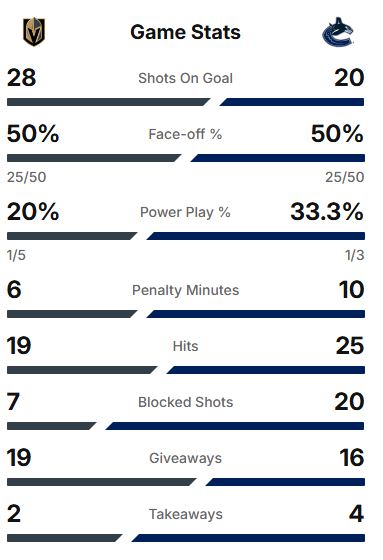
GAME STATS
HIGHLIGHTS
Shortie and Dave back-to-back in the ROG. Like the Canucks.
POST GAME CHATTER!
Elias Pettersson, Paul Cotter and Manny chat about a fine game that was on a fine line.
This amazingly delightful (rebuild) home stand is over. Taking the vibes on the road.
Enjoy the wild roadwork!
I am keeping this feeling with me for the rest of the year.
-- Thursday
Keep On ROGing in the Rebuild World
GOLDEN KNIGHTS (1-1-0) at CANUCKS (2-1-0)
Rogers Place, Vancouver, BC
9 p.m. ET; SNP, SCRIPPS
At this point in the long, long season, did you expect the Canucks to be ranked 3rd in the division, while the Scorched Knights to be a lowly 6th place? Of course you did.
Is this game winnable for the Nucks? Maybe. But win or lose, we've already witnessed the most amazing turnaround from bad vibes hockey to really, really good vibes hockey. We're here for the new good vibes.
Golden Knights projected lineup
Ivan Barbashev -- Jack Eichel -- Mark Stone
Brett Howden -- William Karlsson -- Mitch Marner
Trevor Connelly -- Tomas Hertl -- Victor Olofsson
Marc Gatcomb -- Nic Dowd -- Braeden Bowman
Shea Theodore -- Brayden McNabb
Parker Wotherspoon -- Rasmus Andersson
Jeremy Lauzon -- Noah Hanifin
Adin Hill
Carter Hart
Scratched: Dylan Coghlan, Raphael Lavoie
Injured: None
Canucks projected lineup
Marco Rossi -- Elias Pettersson -- Linus Karlsson
Liam Ohgren -- Paul Cotter -- Brock Boeser
Arshdeep Bains -- Max Sasson -- Jonathan Lekkerimaki
Drew O'Connor -- Aatu Raty -- Brendan Gallagher
Zeev Buium -- Filip Hronek
Jamie Oleksiak -- Tom Willander
Elias Nils Pettersson -- Luke Schenn
Kevin Lankinen
Leevi Merilainen
Scratched: Guillaume Brisebois, Victor Mancini
Injured: Jake DeBrusk (illness), Thatcher Demko (hip), Filip Chytil (shoulder)
Status report
Hill will make his first start this season in what is expected to be the lone change to the Golden Knights lineup from a 4-3 loss to the Anaheim Ducks on Friday. … The Canucks did not hold a morning skate after a 4-1 win against the Calgary Flames on Saturday. DeBrusk is questionable after missing his first game of the season, and Lankinen is expected to start after Merilainen made 23 saves in his first start with Vancouver.
Hoping Lanky has a better Finnish...
GAME DAY CHATTER
Petey keeps hitting the right notes. Hard and often.
Good start. Better finish.
GAME DAY BATTLE HYMN
80s Retro ROG Sunday? Why not. Nucks have delivered more 80s firewagon hockey in 3 games than 50 games from last season. Maniacs.
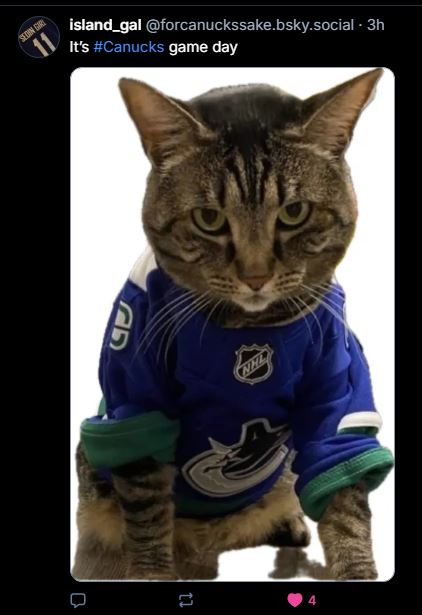
Go Canucks Go.
Nucks Defeat Cheapshot Clowns 4-1.
Rebuild Rules state 1st and/or 2nd periods in the ROG are pretty much pre-game exercises.
Some watched the 1st period of the 1st home game of this new season. And saw what I saw. A sluggish start from the Nucks - per Rebuild Rules: "Start slow, finish frantic".
Although... giving up a PP goal to Cowtown after failing to score on their own 2 extra man that can't enter the O-zone chances was a little... too rebuildish. But still... rebuild rules.
Canucks put 5 shots on all-world goalie, Cooley. Flames had 11 and a goal. 1-zip far out-of-towners after 1.
There was also a 2nd period in the ROG. That was the same as the 1st, except cheapshot artiste, Bahl, knocks R2 head-first into the boards. Got 2 minutes for the Nucks to not score.
That was a dirty ass hit.
-- Twitch
However, Nucks didn't allow any more GAs and got 9 shots despite a flurry of ineffective power plays to prep themselves for...
The Game Start. Period 3. Or 1 in Rebuild parlance.
A buck and change in and Öhgren scores a goal that for sure, for sure, would be called back as Cooley 'appears' to swipe the puck off the goal line before it crosses.
Yeah, that's no goal.
-- Twitch
But, on review, it was a good goal!
Tie game - Rebuilding Canucks game was just getting started. Why play hard for 40 when you can just razzle dazzle for 20? Don't know.
It's 4-on-4 hockey because reasons... Öhgren passes to a sneaky Petey who lofts a beauty backhand over Cooley, former all-world goalie. GWG for Petey!
2-1 Nucks and then Petey lays a big open ice hit on fancy new Cowtown D man. While a CowClown is busy mugging Petey for the clean hit, DOC breaks in 2-on-1 to score on Cooley, former all-world goalie.
To Be Clear
It was D-Petey with the sneaky backhand to score.
EP40 is the Pettersson who delivered the big open ice hit that led to DOC's goal. Sounds like I'm making it up. Even I couldn't make that up.
Good lord: another EIGHT hits for Pettersson the Forward tonight. He may well lead the league after tonight.
Elias Pettersson is reborn in a whole new form. Holy Smoke.
-- Thursday
LEADING!
3-1 Nucks with 4 mins to go. It's a 2 goal lead. As we know, it's the safest lead in hockey.
But just in case, as the CowClowns empty their net to try the over-clowned option, Öhgren passes to R2 for the EN and a little payback for the cheapshot he took.
Nucks close out the game to win! In the ROG!
Just as Manny might have planned it. If he was into the Rebuild Rulebook as deeply as we are.
Canucks weathered the big boy hockey cheapshots, getting goalied through 40 and tilted the ROG ice to score 4 goals in a single period - the last period. Outshooting the visitors 12 to 5 in the 3rd. The period that counts. The one we will remember.
We're undefeated in the retros!
-- Twitch
Are we allowed to be a .666% winning while rebuilding team destined to pick 1st next year? Don't know, don't care.
SKY WORDS!
Sure, we've given up our special place in the basement. For now. If the Nucks special teams aren't going to be more special this season, we'll get it back, no problem.
Relevant Game Notes
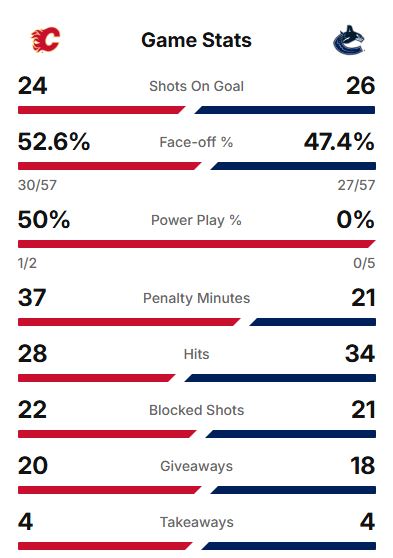
GAME STATS
Great stats. Not great PP stats. 1 out of 2 ain't so bad.
HIGHLIGHTS
Shortie and Dave back in winning ROG form. Like the Canucks.
POST GAME CHATTER!
Öhgren, Meriläinen, D-Petey and Manny talk an intense 3rd period comeback that worked.
While we're having fun tonight, tomorrow is another day, another game. A game against the Lost Wages desert rat hockey club. Oh well..
Enjoy the wild, wild ride!
I am keeping this feeling with me for the rest of the year.
-- Thursday
Regular ROG Night of the Rebuild Returns
FLAMES (0-1-0) at CANUCKS (1-1-0)
Rogers Place, Vancouver, BC
10 p.m. ET; SN, TVAS2
Battle for the Basement begins now. Cowtown lost their home opener - badly. Canucks lost theirs - really well.
These teams are/were projected to finish in the bottom of the division. Cowtown has the lead as the worst. Part of us wants them to keep it. The DuPont part of us does not. So early in the season to be conflicted. Good start!
Flames projected lineup
Matvei Gridin -- Morgan Frost -- Matt Coronato
Samuel Honzek -- Mikael Backlund -- Joel Farabee
Brennan Othmann -- Ryan Strome -- Yegor Sharangovich
Maksim Tsyplakov -- Martin Pospisil -- Adam Klapka
Joel Hanley -- Simon Nemec
Kevin Bahl -- Zach Whitecloud
Jake Middleton -- Zayne Parekh
Devin Cooley
Dustin Wolf
Scratched: Connor Zary, Brayden Pachal, Yan Kuznetsov
Injured: Jonathan Huberdeau (hip)
Canucks projected lineup
Marco Rossi -- Elias Pettersson -- Linus Karlsson
Liam Ohgren -- Paul Cotter -- Brock Boeser
Arshdeep Bains -- Max Sasson -- Jonathan Lekkerimaki
Drew O'Connor -- Aatu Raty -- Brendan Gallagher
Zeev Buium -- Filip Hronek
Jamie Oleksiak -- Tom Willander
Elias Nils Pettersson -- Luke Schenn
Leevi Merilainen
Kevin Lankinen
Scratched: Guillaume Brisebois, Victor Mancini
Injured: Jake DeBrusk (illness), Thatcher Demko (hip), Filip Chytil (shoulder)
Status report
Othmann replaces Zary, a forward who will be a healthy scratch. … Hanley replaces fellow defenseman Kuznetsov and will play alongside Nemec instead of Bahl, who is now paired with Whitecloud. … Cooley makes his first start of the season. ... DeBrusk won’t play because of illness, according to Canucks coach Manny Malhotra, after skating as an extra forward in practice on Friday. … Vancouver held an optional morning skate but based on practice Friday, Cotter will move up from the fourth line to take the place of Rossi, who will skate at left wing on the first line, and Raty will enter the lineup after two games as a healthy scratch. … Merilainen will make his first start since being claimed off waivers from the Ottawa Senators on Sept. 25.
Hmmm... DeBrusk has the rebuild flu so soon...
GAME DAY CHATTER
That's another win from that winning series.
Again the Vancouver sports media misconstrues a win as a loss. Don't ask me to explain the Rebuild Rules again. Flames fans might be listening.
GAME DAY BATTLE HYMN
Prog ROG Saturday? Maybe. What has this got to do with a rebuild? Probably nothing, since the Nucks rebuild is over until next season.
Go Canucks Go.
Nucks Defeat McOil 7-5 in final 2 periods.
Rebuild Rules state 1st periods in the ROG don't count. 5-0 Oil after 1.5 thing is not important.
Some watched the 1st period of the 1st home game of this new season. I didn't. Because I knew the rules. I didn't see the Nucks get down 4 goals on 14 shots while only getting 2 shots of their own. The poor fans who watched that period must have had many Footie flashbacks from last year in the ROG. I didn't.
The Game Starts. Period 2.5(ish). Or 1 in Rebuild parlance.
As crazy as the opening 'demo' period was - or disheartening, the next 1.5 periods saw the New Nucks come back to score 3 goals in the 2nd, while only giving up 4. Giving up 2 while on the same Nucking PP was a bit 'so Canucks', but whatever.
Even better, the Nucks start the 3rd barely down five goals, 8-3. Seems like the Oil are skating away with the big league lead. Not quite.
While Manny might have said a few motivational words, the 3rd period Nucks were highly motivated. Motivated to score 4 goals.
Who knew it was 80s retro pond hockey night in the ROG. I mean other than us long retro Nucks fans.
How insanely crazy was it to watch the formerly mighty Oil almost lose the game?
THE LUNACY CONTINUES!
Hockey is such a ridiculous game. 😎
-- Thursday
Normally I might recount the Nucks goals... but did we recap every goal in the 80s? No, we didn't. Otherwise we'd still be living in the 80s with inappropriately big hair.
Watch the highlights. Starting after the period that doesn't count. Just ask Lanky... who was pulled before the actual game got going. Or the Nucks got going. Lanky gave up 8 goals and new hire, Meriläinen, gave up one.
Doesn't matter.
What matters is the Nucks came back to win the last period. And if that single Canuckian PP had not given up 2 goals, it would have been a tie and Nucks would have won in OT. Instead they had to win 7-5 in the regular two periods. I'm not making it up. The Rebuild Rule Book is.
We earned our dignity back, in this period.
-- Atty
How ca-ca-crazy are we Nucks now?
Crazy stat line too...
Also... the Nucks were the better 5-v-5 team. Out scoring Oil 6-5. The special oily teams were more special or the Nucks on that one tepid and disastrous PP was less than special.
But still... Nucks came back like a burning blaze of firewagon hockey on 80s skates.
This game feels like a win to me!
The Oilers had to give everything they've got, to beat us by 1 goal in the combined 2 games.
That's surreal.
-- Atty
They scored nine goals and it was still a disaster for them. 😎
-- Thursday
Haha, you score 9 goals and feel like a loser!
--Atty
According to rulebook lore, the 5 goals the Oil scored in the preparation phase were not meant to be counted towards the final tally. Someone needs to brings this up at the next meeting of the Bored of Governors.
Until then, we can just savour the mayhem. Win or lose games, when they are this freaking entertaining, who cares?
The new Nucks took it to the old Babbsie Oil. And never gave up. Except in that preparation period and horribly tentative PP that we will never mention again, because the Alien is back on planet PP. His rocket in the 3rd brought back pleasant Petey memories. What if he gets back to form?
But we have other more pressing scoring stats to ponder...
It was a wide open game the Nucks nearly closed down... or wait... they did.
Relevant Game Notes
HIGHLIGHTS
ROG hockey we know is back with Shortie in the 1st. Fortunately the next periods were refreshingly different.
POST GAME CHATTER!
Brock, Cotter, Schenny and Manny talk about mad mad hockey with a crazy comeback that almost worked.
Savour the mistakes, the pushback, the process... We're still #1-to-5(ish). Almost, pretty much.
Not that we're counting wins and points... unless we go on a stupid win-streak then we will both enjoy it and lament it, because despite the claims (that I made) about the rebuild being complete, Nucks could do with a couple more top 5 picks.
What a way, the cray cray way to start the new Nucks season.
Enjoy the next 82 games!
I am keeping this feeling with me for the rest of the year.
-- Thursday
The ROG night of the rebuild win streak begins
OILERS (0-0-1) at CANUCKS (1-0-0)
Rogers Place, Vancouver, BC
10 p.m. ET; SN1, SNP
It has started. The 1st home game of the season... against the team who had their home opener ruined - by the formerly last place Canucks.
What a fun season opening game! Manny has delivered on the team work ethic. Before we go full giddy on a season opening win streak, expect the mean old Babbs and his Team of Entitlement will be feeling even more entitled - featuring a less jittery goalie.
Oilers projected lineup
Vasily Podkolzin -- Connor McDavid -- Leon Draisaitl
Max Jones -- Colton Dach -- Kasperi Kapanen
Alex Formenton -- Owen Michaels -- Mathieu Joseph
Isaac Howard – Josh Samanski -- Trent Frederic
Mattias Ekholm -- Evan Bouchard
Ryan Shea -- Connor Murphy
Jake Walman -- Shakir Mukhamadullin
Devon Levi
Tristan Jarry
Scratched: Ty Emberson, Spencer Stastney
Injured: Zach Hyman (upper body), Frederik Andersen (undisclosed), Jason Dickinson (undisclosed), Mattias Janmark (undisclosed), Ryan Nugent-Hopkins (lower body), Alec Regula (undisclosed), Matt Savoie (undisclosed)
Canucks projected lineup
Jake DeBrusk -- Elias Pettersson — Jonathan Lekkerimaki
Liam Ohgren -- Marco Rossi -- Brock Boeser
Drew O'Connor -- Max Sasson -- Linus Karlsson
Arshdeep Bains -- Paul Cotter -- Brendan Gallagher
Zeev Buium -- Filip Hronek
Jamie Oleksiak -- Tom Willander
Elias Pettersson -- Luke Schenn
Kevin Lankinen
Leevi Merilainen
Scratched: Aatu Raty, Guillaume Brisebois, Victor Mancini
Injured: Thatcher Demko (hip), Filip Chytil (shoulder)
Status report
Hyman, a top-line forward, is listed as day to day, but Oilers coach Mike Babcock said, “I think that means two weeks.” Babcock said Hyman was injured in the final preseason game against the Calgary Flames but played through it in a season-opening 6-5 overtime loss to the Canucks on Tuesday. … Nugent-Hopkins, a center who was injured at the end of practice Monday, was placed on injured reserve Wednesday and Samanski was recalled from Bakersfield of the American Hockey League. … McDavid and Draisaitl, who played most of the preseason together, were reunited during the morning skate after starting the season opener on separate lines following the injury to Nugent-Hopkins. … Levi is making his Oilers regular-season debut. … The Canucks are dressing the same lineup they used Tuesday.
GAME DAY CHATTER
GAME DAY BATTLE HYMN
It's Canadian sonic legend Angine de Poitrine performing their famous song that is almost as catchy as their stage presentation.
Go Canucks Go.
Nucks Defeat McOil 6-5 in OT! (not making it up)
Rebuild is complete! Canucks tied for the league lead!
Under promise and over deliver. That's what the new Nucks white-collars have done all summer. Low expectations, high standards.
This opening game has proved the Canucks chose the best coach to lead this (nearly) complete contender. Manny is undefeated at the NHL level. Sure... small sample size, also what is sure, he has prepared this team very well.
How well? Better than we could have hoped for. Canucks open this season in the basement of Oil Town. A rink filled with hideous hi-vis safety vests for the loyal oil fans. Turns out they were actually life vests...
Canucks' new Canuck, Cotter scored the game opening goal. On the PK! No, really.
Unsurprisingly, Oil tied it. 1-1 after 1. And Nucks are leading. Not on the shot clock. That was 13-5 for the oily hosts. Nucks were leading on the underdog clock. And Lanky was dialed in.
In the 2nd, the Nucks score 1st again.
Öhgren sends a spinorama pass up ice to Rossi who skates in on jittery Jary to score.
2 goals on 6 shots! When will the coilers turn their attention to getting a goaltender?
-- Ripper
Sure... the Boooochard'd Oil tie it up. Doesn't matter. We're still winning. Even on the shot clock. Almost, as the Oil outshot us a little, 9-7.
We're so ready for the 3rd. The host teams and fans not so much. In the opening 5 minutes Canucks take over the game. For real.
Lasermäki shoots a laser right through Jary. 3-2 Nucks.
Then Maximum Sassy puts on the jets as McJ gives up the puck at the Nucks end. Passes to DOC, who passes back to Speedy Sassy who whips the puck through the jittery wickets. 4-2 Nucks.
Into the first 12 seconds of the Nucks first PP of the game, Petey tips Ronnie's shot. 5-2 Nucks.
Nucks, the (allegedly) worst team in league are up 3 goals on the (allegedly) 2nd or 3rd best team in the division.
A few minutes later our old Podz beats Lanky. We dinna care. The Nucks are playing way better than expected.
Then it's time in the well-oiled rink for the refs to make the ice slimy. Think they call it 'working the refs' in the NHL. In Oil Town they call it entitled to many favourable calls.
And the Oil don't score on it. But Boooochars pots another for the hattie. We don't care. We're still winning.
But then... the refs jobbed us again. Karlsson is called for slashing Eckholm... he didn't... Eckholm mugged Karlson - and we're penalized for it.
With less than 2 minutes to go in the 3rd, Oil have to go 6 on 4 to get the tie. Wimps.
We still don't care. Sure it was a little upsetting for the Oil and their NHL officials to get back to the odd even tie, but it doesn't matter to us.
Wow.
Only the first game, but it may end up to be the most exciting game of the season.
-- Atty
This game was supposedly going to end with the Oil entitled to a 5-1 bruising of our basement club. Not on this night, ya Babbsies.
3-ON-3 OT
OMG! OMG! McSaddles in OT are so going to win, because Gary designed this extra period for the Elites to watch the Elites score goals. Lots of goals. Or just the one.
And yet... in lunchbucket fantasy fashion, it ain't McD nor Dry, nor EP40, but the Nucks (potent) 4th liners, Sassy and Cotter who outwork the foiled oil in their own end. Cotter takes the puck away gets knocked down for his troubles, passes to Sassy while laying on the ice. Gets back up to take the pass back from Sassy and calmly, cooly in simple 4th liner style dekes out Jary to score the GWG! THE GWG!
Underdog Nucks defeat the overdog Oilers 6-5 in the best game of the season!
WOOOOO!!!
Score first in the first; first in the second; first in the third; first in overtime!
-- Thursday
PAUL COTTER OPENS IT, PAUL COTTER CLOSES IT!
-- Thursday
HIGHLIGHTS
So Manny highlights... shame sportynet cheaped-out with homer-oil coverage. Oh well... we dinna care!
Wanna watch the full OT as the McOil lose? Of course, you do.
POST GAME CHATTER! Wooo!
Petey and Manny talk about this early season barn burner.
This was a statement game. What a wonderful statement.
Also...savour the moment... We're #1. Pretty much.
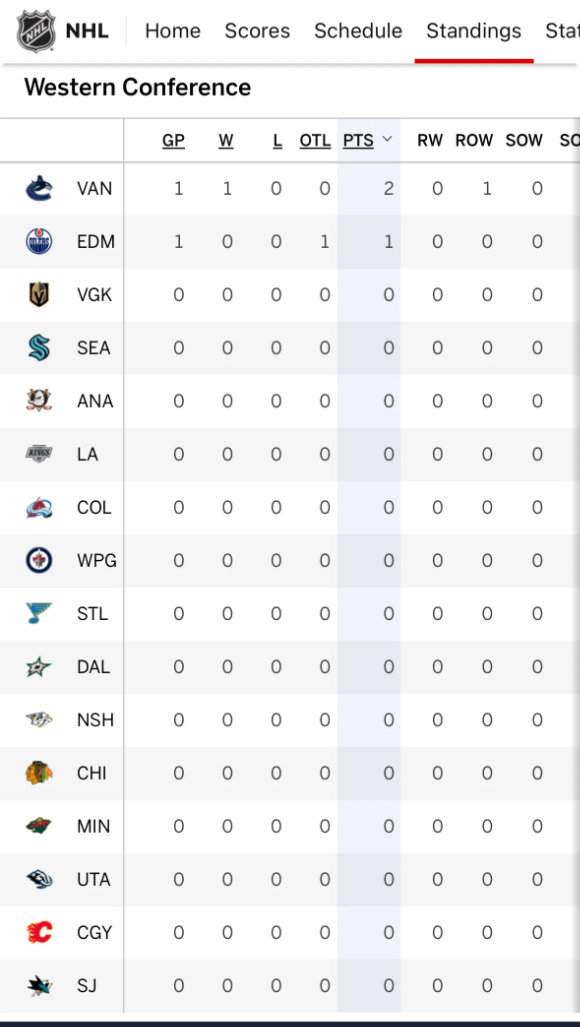
Not that we're counting wins and points... just enjoying the process - an energized process where the Nucks are playing like a team that plays for each other - already. Manny wins on his NHL coaching debut - his new team won on their debut. We can't ask for better.
Enjoy the next 83 games!
I am keeping this feeling with me for the rest of the year.
-- Thursday
The long night of the rebuild soul begins
CANUCKS (0-0-0) at OILERS (0-0-0)
Rogers Place, Edmonton, AB
10 p.m. ET; SN
It has started. The long, long march of 84 games towards picking 1st. Or 10th. NHL rules.
Will be fun interesting to watch how this game, this season unfolds. Thursday has previewed both HERE. No need to speculate more. This is no time for speculation, this is the time of stoic indeterminate patience.
Canucks projected lineup
Jake DeBrusk -- Elias Pettersson -- Jonathan Lekkerimaki
Liam Ohgren -- Marco Rossi -- Brock Boeser
Drew O'Connor -- Max Sasson -- Linus Karlsson
Arshdeep Bains -- Paul Cotter -- Brendan Gallagher
Zeev Buium -- Filip Hronek
Jamie Oleksiak -- Tom Willander
Elias Nils Pettersson -- Luke Schenn
Kevin Lankinen
Leevi Merilainen
Scratched: Aatu Raty, Guillaume Brisebois, Victor Mancini
Injured: Thatcher Demko (hip), Filip Chytil (shoulder)
Oilers projected lineup
Isaac Howard -- Connor McDavid -- Zach Hyman
Vasily Podkolzin -- Leon Draisaitl -- Kasperi Kapanen
Alex Formenton -- Colton Dach -- Mathieu Joseph
Max Jones -- Owen Michaels -- Trent Frederic
Mattias Ekholm -- Evan Bouchard
Jake Walman -- Connor Murphy
Ryan Shea -- Shakir Mukhamadullin
Tristan Jarry
Devon Levi
Scratched: Ty Emberson, Spencer Stastney
Injured: Frederik Andersen (undisclosed), Jason Dickinson (undisclosed), Mattias Janmark (undisclosed), Ryan Nugent-Hopkins (lower body), Alec Regula (undisclosed), Matthew Savoie (undisclosed)
Status report
DeBrusk is expected to play after missing practice Monday because of a lower-body injury sustained while blocking a shot by Boeser in a preseason game against the Seattle Kraken on Saturday. “Everyone is available,” Canucks coach Manny Malhotra said. … Nugent-Hopkins, a forward, was injured at the end of practice Monday and will not play; Draisaitl was moved to second-line center after he’d been practicing with McDavid. Jones is expected to take Nugent-Hopkins’ spot in the lineup.
GAME DAY CHATTER
We know it's going to be a difficult season for #Canucks fans. It's the nature of the game - especially when your team is FINALLY doing a rebuild with all the white-collars in agreement. So how do we survive the year with our minds intact? I made a handy guide: nucksmisconduct.ca/how-to-watch...
— Erin Butler (@eleighbutler.bsky.social) September 29, 2026 at 11:21 AM
[image or embed]
GAME DAY BATTLE HYMN
Gotto go with a Canadian artist who cares not of wet coast Canuckian struggles against the NHL and CoTU... but what if he did?
Go Canucks Go.
And then there were twenty-three.
The Vancouver Canucks have trimmed the roster, used the injured list, and are off to Edmonton for the season opener. There is no way this roster remains as it is through 84 games, but at least we know where it starts.
It is a little surprising that the only player on the waiver wire Vancouver took a stab at is Leevi Merilainen. He's a good, low-risk pickup, no complaints there. But there were several other younger players readily available, and the Canucks have first dibs. It could be a show of confidence, or exercising caution in shaking up the prospects too much. No one wants to get sent down, but even worse is seeing new players come in ahead of you.
Heading down despite some very good pre-season play was Arshdeep Bains. Bains' biggest problem has been an apparent reluctance to play the same way in the NHL as he does in the AHL. His top priority was not making mistakes instead of bringing his game. To be fair, in the NHL he's on the fourth line, and the objective is very different than his top-line AHL spot.
This camp, though, he was more aggressive on the attack, willing to make dangerous passes, and - Oh, he is? Good for him! Who's down?
*sigh*
I like watching Filip Chytil play. I do. The guy was a first-round pick for a reason. But sometimes the best ability you can have is avail. At least we've been reassured that this time it's his shoulder rather than another concussion. Oh, and it looks like Thatcher Demko will be out until Christmas.
Surgery on both hips is no joke, but apparently expecting him back in a reasonable amount of time is. His last surgery was in January, and while he's been on the ice, he hasn't skated with the team. This likely kills any hope of trading Demko, at least for this season. The team has 24 games between January 1st and trade deadline day. Any general manager taking on Demko after seeing him healthy for maybe fifteen games probably isn't keeping his job for long.
Instead of giving Nikita Tolopilo the backup job behind Kevin Lankinen, the waiver-proof goalie will start once again in Abbotsford.
This complicates things with presumed Baby 'Nucks starters Aku Koskenvuo and Ty Young. Both split the season between Kalamazoo and Abbotsford last season, but I can't say which is preferred to stay up now. Can't imagine anyone wants a three-goalie rotation in the AHL, and no way would Tolopilo take a demotion to a league he's never played in.
Both Chytil and Demko are starting the year on the Injured Reserve list, since it would be pointless to move them to LTIR. Vancouver's around $16 million away from the salary cap, so no money will be saved with such a move.
Opening the season against the Oilers with their new coach, Mike "Last Ditch" Babcock, makes for an interesting start. Edmonton is notorious for their slow starts to the season, and the Canucks are... Well, we don't really know. There may have been a sign with the mostly NHL Vancouver squad getting smacked by a mostly Bakersfield team, but that was also the first day the Canucks played together.
Don't get me wrong, the Canucks deserved to lose that game. But part of that was by looking rusty as hell. We're just going to have to see what kind of effort Manny Malhotra will get now that the numbers start adding up. We'll also get a look at what the lines might look like for the bulk of the season. Except, of course, this is Vancouver, where injuries are a way of life.
Jake DeBrusk is with the team in Edmonton, but was also held off the ice before they went because of a "lower-body injury". No one's saying what exactly the injury is, but he did score one off his butt against Seattle on Saturday. Brock Boeser may owe Jake a dinner or two, is all I'm saying.
Bains could well get the spot beside Elias Pettersson the Forward and Jonathan Lekkerimaki, which isn't a bad way to start the year. If DeBrusk makes it back, then he's the obvious choice as a scratch. Guillaume Brisebois and Victor Mancini are probably the extras on defence, keeping with this year's "Old Guy - Young Guy" pairings.
Lankinen will start in goal, which is going to be a running theme this season.
The Canucks want a low-event game where they hold the puck as long as possible. The last thing Malhotra wants is for his forwards to enter the zone firing, giving opponents a chance to get the puck back. This isn't just a plan against Edmonton and other high-powered teams, but against everyone in the league. Which, to be fair, will feel like high-powered teams compared to the Canucks.
Ruining Babcock and the Oilers' home opener would be a fun way to kick off the year, but isn't all that likely. It would be even more fun to beat them in our own first at home - but that also isn't likely. They are going to be a hard watch this year, no lie. Fortunately, we've put together a self-defence guide to help: How to Watch Canucks Games.
Keep your guide handy, and remember: we're doing this for The Future!

